
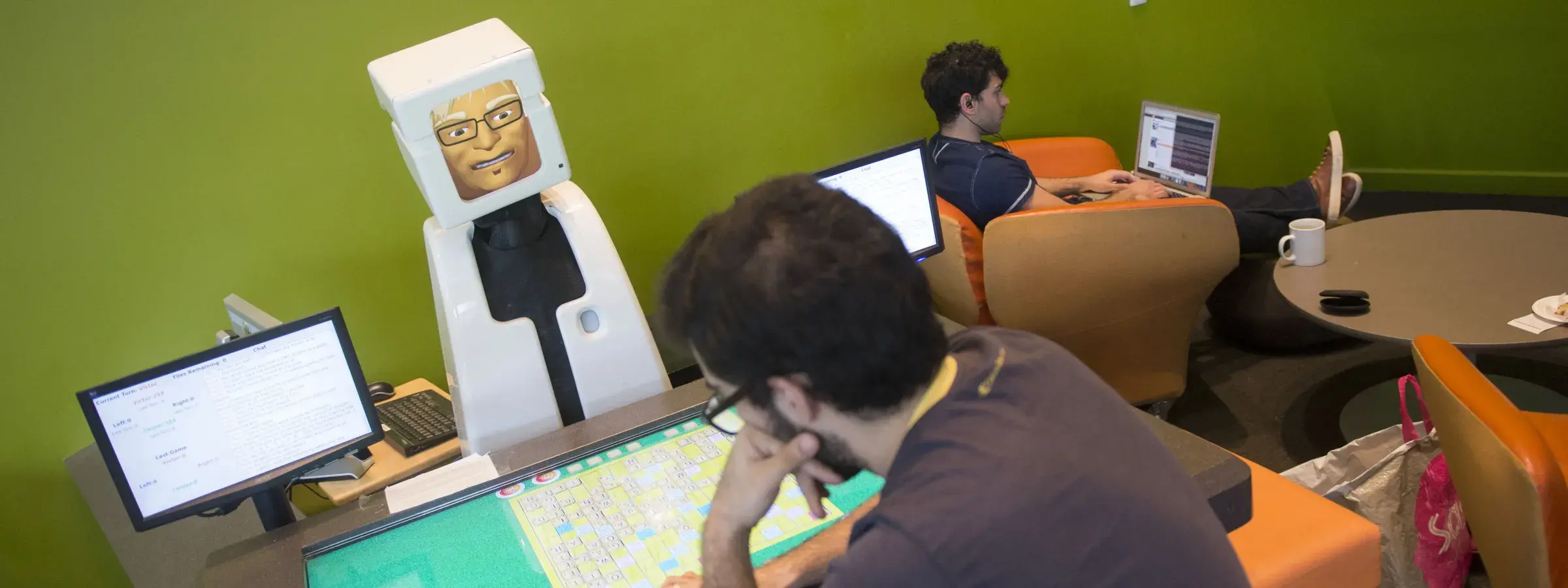
Artificial Intelligence
Carnegie Mellon has been a leader in Artificial Intelligence (AI) research since Herbert Simon and Allen Newell invented the field in the 1950s.

Artificial Intelligence has evolved to address problems of probabilistic and numeric nature, leading to the incorporation of approaches from mathematics, engineering, operations research and economics. Our researchers scientifically build upon each others’ work, and research from other disciplines, creating analytical and highly systematic experimental work. The resulting AI systems can deal with uncertainty — both in an objective sense and in the sense that arises in those AI applications that include non-trivial perception.
The explosion of computerized information on the Internet, in data warehouses, and from physical sensory artifacts has also created large-scale problems for AI research. Carnegie Mellon has been at the forefront of that progress, with pioneering innovations in intelligent digital libraries, data representations and algorithms, market clearing technologies, and complex task-embedded robotic applications.
Carnegie Mellon faculty are recognized for their leadership in expanding beyond monolithic AI to multiagent systems, where the key challenge is the intelligent interaction of multiple parties. Finally, Carnegie Mellon faculty have led AI from the abstract (“Can one build a thinking machine?”) to a host of concrete applications and techniques that are significantly improving the world.
News

Sandholm Receives SIGecom Test of Time Award
Adam Kohlhaasby Adam Kohlhaas | Friday, June 5, 2026
Tuomas Sandholm, the Angel Jordan University Professor of Computer Science at Carnegie Mellon University, and his co-authors have received the ACM SIGecom Test of Time Award for their 2007 paper, "Automated Online Mechanism Design and Prophet Inequalities." Read MoreFaculty Researchers Working in this Area
-
Maria Balcan
Cadence Design Systems Professor
-
Tianqi Chen
Associate Professor
-
Vincent Conitzer
Professor
-
Tim Dettmers
Assistant Professor
-
Chris Donahue
Assistant Professor
-
Christos Faloutsos
Fredkin University Professor of Computer Science
-
Jessica Hodgins
Allen Newell University Professor of Computer Science And Robotics
-
Zhihao Jia
Assistant Professor
-
Takeo Kanade
SCS Founders University Professor
-
Aviral Kumar
Assistant Professor
-
Tai-Sing Lee
Professor
-
Minchen Li
Assistant Professor
-
Tom Mitchell
SCS Founders University Professor
-
Matthew O'Toole
Associate Professor
-
Nancy Pollard
Professor
-
Aditi Raghunathan
Assistant Professor
-
Raj Reddy
Moza Bint Nasser University Professor
-
Feras Saad
Assistant Professor
-
Tuomas Sandholm
Angel Jordan University Professor of Computer Science
-
Nihar Shah
Associate Professor
-
Reid Simmons
Research Professor
-
Dimitrios Skarlatos
Assistant Professor
-
Danny Sleator
Professor
-
David Touretzky
Research Professor
-
Weina Wang
Associate Professor
-
David Woodruff
Professor
Doctoral Researchers Working in this Area
-
Bhavya Kumar Agrawalla
-
Victor Akinwande
-
Ioannis Anagnostidis
-
Ratip Emin Berker
-
Aviv Bick
-
Irmak Bukey
-
Wayne Chi
-
Eulrang Cho
-
Kiriaki Fragkia
-
Apurva Gandhi
-
Zhengyang Geng
-
Alexander Goldberg
-
Keerthana Gurushankar
-
Stephen Huan
-
Jerry Huang
-
Andreas Kalavas
-
Eungyeup Kim
-
Juho Kim
-
Yewon Kim
-
Madeline Kitch
-
Lingjing Kong
-
Tianqin Li
-
Jiayuan Liu
-
Trang Nguyen
-
Lara Pinto Sá Neves
-
Nathan Pruyne
-
Ava Pun
-
Yash Savani
-
Max Sobol Mark
-
Emanuel Tewolde
-
Abitha Thankaraj
-
Barry Wang
-
Yixuan Xu
-
Ziqian Zhong
-
Itai Zilberstein